Modern Tuscan: The Grounded Luxury Trend and How to Get the Look with the Right Rug
Last updated on July 28th, 2026
Grey had a long run. Now it’s over. In 2026, the interiors dominating design coverage share a different palette: warm sand, aged ivory, muted sage, soft terracotta. The trend pulling them together is modern Tuscan interior design, and it’s less a revival than a correction. After years of cool minimalism, people want rooms that feel lived in, made from real materials, and built to last. Across modern Tuscan style homes and apartments alike, natural fiber rugs (wool especially) are usually where it starts.
Why is the modern Tuscan aesthetic having a moment right now?
Trends move in reaction. The all-white, handleless-cabinet, grey-floor aesthetic that defined the 2010s was clean, yes, but it also felt like a waiting room. By 2026, the question everyone in design was asking, what color is replacing grey, had a clear answer: not one color, but a whole family of warm, grounded neutrals. Younger homeowners especially started pushing back. They wanted texture, warmth, things that carried some sense of history.
Modern Tuscan delivers all of that without asking you to cover your walls in faux-finish terracotta. It borrows the soul of Italian farmhouse design, the craftsmanship, the natural materials, the unhurried quality, and updates it for rooms that still need to function in 2026. Limewash walls instead of Venetian plaster. Bouclé instead of velvet. A hand-knotted wool rug in ivory instead of a medallion runner in burgundy.
The mood is a sun-drenched farmhouse with very good taste. Not a theme park.
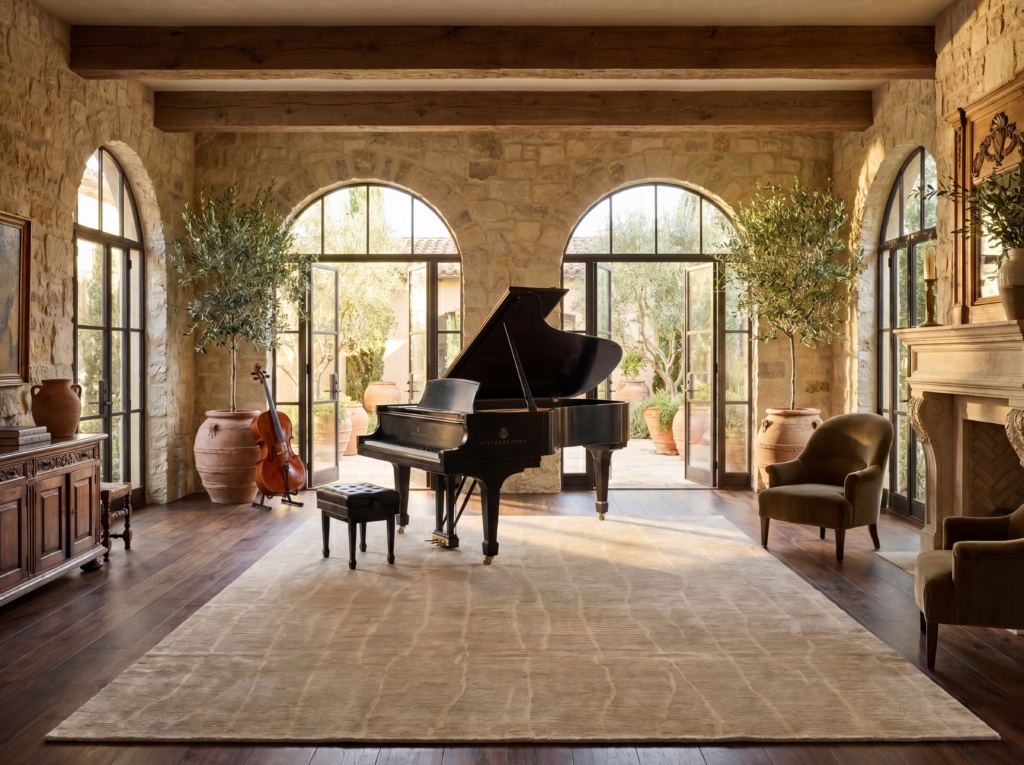
What makes modern Tuscan different from the original Tuscan look?
If you lived through the early 2000s version, you remember what it looked like: dark red accent walls, heavy scrollwork, countertops in chunky granite, every surface competing for attention. It was a lot.
The new version does the opposite. It edits. It strips away the ornamental layer and asks what the room feels like to actually be in. The result is lighter, airier, and far more considered. That shift is what defines modern Tuscan interiors today: every element earns its place.
A few specific differences worth knowing:
- Color: the early version went deep, dark, and warm. Modern Tuscan stays in warm neutrals: sand, ivory, greige, soft sage. Terracotta appears as an accent, not a dominant wall color.
- Materials: then, the emphasis was on ornamented surfaces. Now it’s on honest ones. Stone, unfinished wood, undyed linen, hand-knotted wool.
- Pattern: the old look loved a scroll, a medallion, a heavy motif. Modern Tuscan prefers texture over pattern. A rug with carved dimensional detail reads far better in this aesthetic than one with a busy field.
- Weight: furniture and accessories are lower, wider, quieter. Nothing competes. Everything contributes.
The phrase designers use most often is “grounded luxury home.” It’s an accurate description: the warmth and craftsmanship of something old, the restraint and confidence of something considered. That’s the target.

Which rug materials work best for the modern Tuscan aesthetic?
This is where the decision gets specific, and specifics matter. Modern Tuscan is a style defined by material honesty. The rug should feel like it belongs to the same family as the linen on the sofa and the stone on the floor. Here’s how the main options compare:
Wool: The first choice for a reason. Wool has natural luster, holds dye well in warm, tonal colorways, and improves with age rather than degrading. A hand-tufted or hand-knotted wool rug in ivory, sand, or warm grey will anchor a Modern Tuscan room without overpowering it. New Zealand wool is worth specifying if you can: the fiber is longer, softer, and carries a subtle sheen that reads as quietly expensive without being shiny. Explore more facts about wool rugs here.
Wool and silk blends: The most refined option in this category. Silk adds a directional sheen, catching light differently depending on the angle, which gives a hand-knotted wool/silk rug a depth that flat photography rarely captures well. In a room with high ceilings and good natural light, it reads as one of the most considered things in the space. These rugs are investments, not impulse buys, and that suits the modern Tuscan philosophy exactly.
Natural jute: A good supporting player. Jute’s coarse texture and warm straw tone work well in casual, sun-filled rooms: a sunroom, a covered terrace, a kitchen with stone floors. It’s less suited to a principal living space, where you’ll want the softness and visual depth that wool provides. Use it as a layering rug or in secondary rooms. Learn more about the unique qualities of jute rugs, including where they perform best and how to keep them looking their best over time.
One rule across all three: prioritize texture over pattern. Modern Tuscan rugs tend to be tonal. Carved pile, subtle abstract motifs, quiet dimensional weave. Anything graphic or ornate pulls the room in the wrong direction.
How do you style a modern Tuscan room? A room-by-room guide
The rug grounds the space, but modern Tuscan is a full-room philosophy. The principle at the center of it is contrast: rough and refined, matte and smooth, old and new. Without that tension, the look goes flat. Here’s how to build it room by room.
Modern Tuscan living room
Start with the walls. Limewash paint or textured plaster finish is the highest-impact single change you can make. The slight variation in coverage catches light differently throughout the day, which is exactly what this aesthetic is after. Stay in the sand-to-warm-white range on walls and let the furniture and textiles carry the deeper tones.
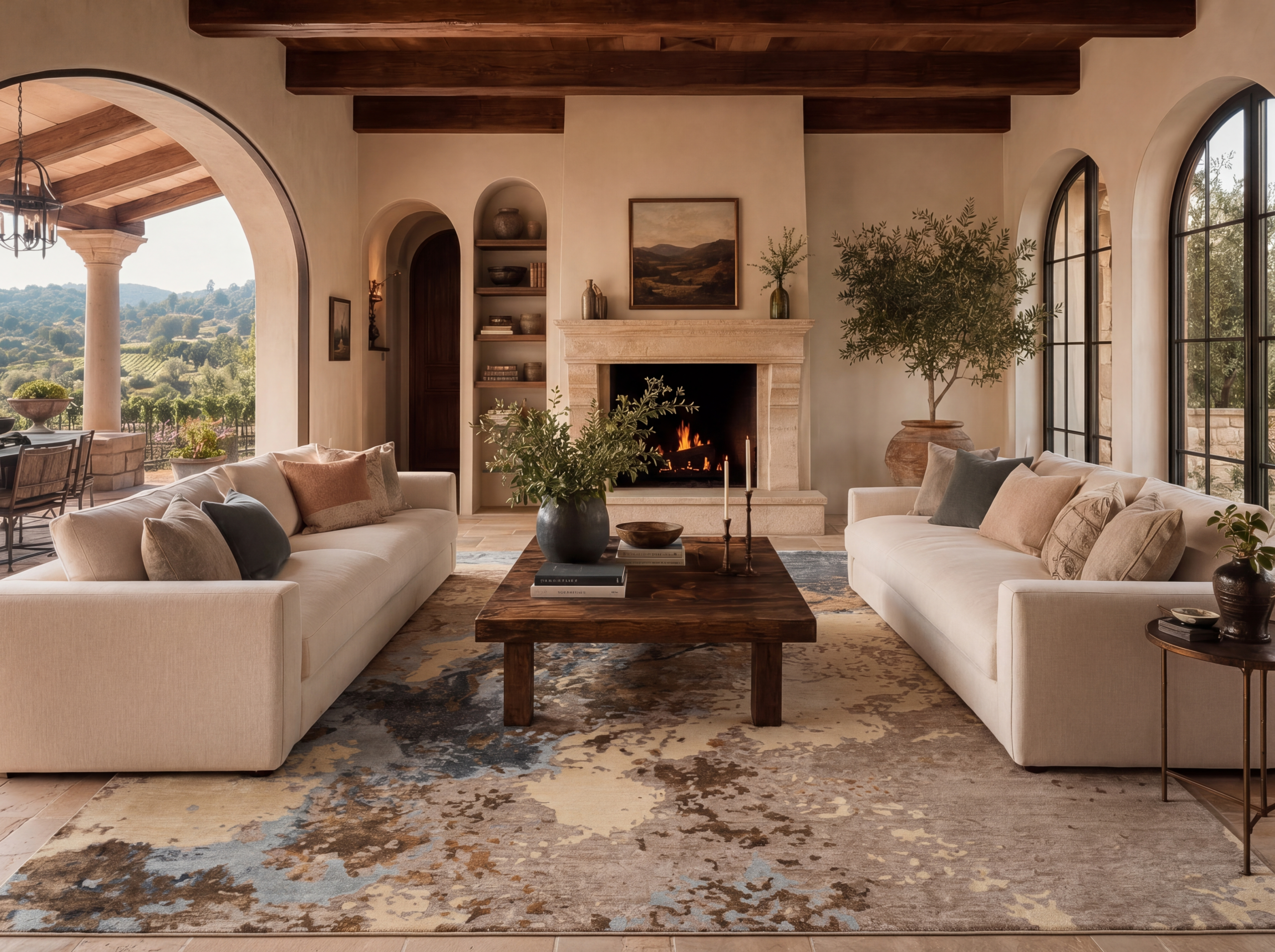
For seating, choose low and wide over tall and upright. When it comes to modern Tuscan furniture, the guiding principle is the same: lower profiles, natural materials, nothing that competes. A bouclé sofa with natural wood legs, a linen-upholstered armchair, a raw-edge wood coffee table with a fluted drum base. The goal is a room that looks assembled over years, not styled in an afternoon.
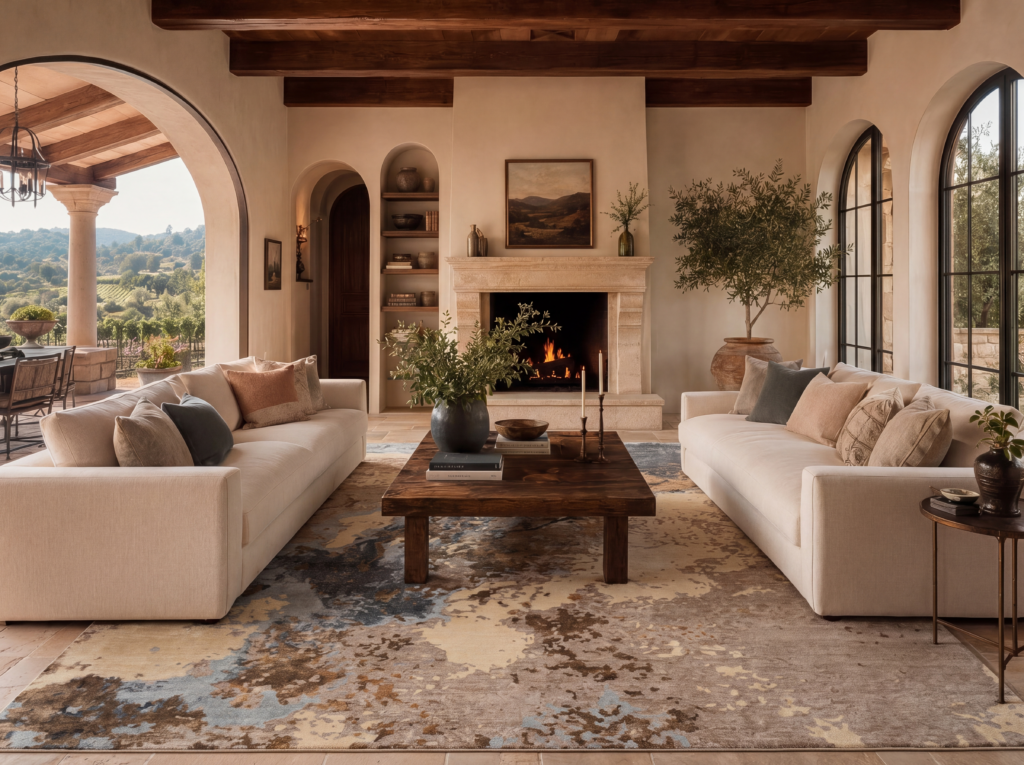
Layer the textiles from the floor up. The rug anchors everything: a hand-knotted wool or wool/silk piece in sand, ivory, or warm grey. Then linen or washed-cotton throw pillows in sage, terracotta, and warm white. A chunky-knit throw over the arm of the sofa. Each layer adds texture without adding noise.
Bedroom
The bedroom is where modern Tuscan does its best work. The aesthetic is naturally suited to rest: warm, low-contrast, material-rich without being visually busy.
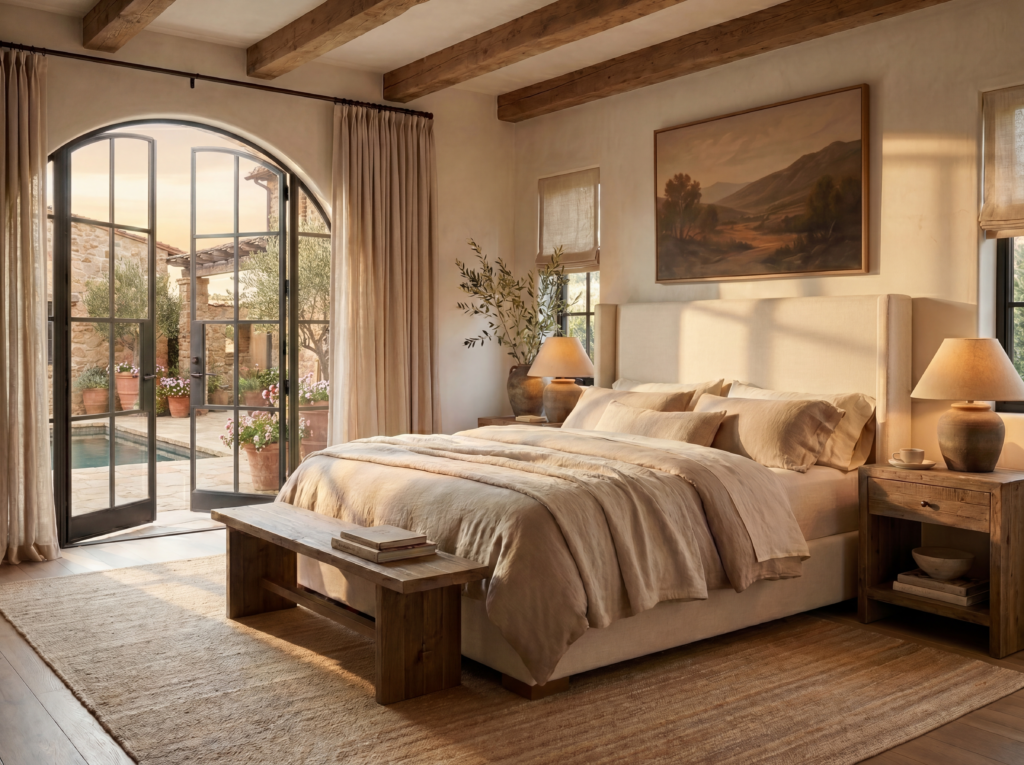
Keep the palette tight. Warm white or aged linen for walls, natural wood for the bed frame, a wool rug that extends well beyond the footboard on both sides. The standard guidance is at least 18 to 24 inches of rug visible on each side of a queen or king bed. In a modern Tuscan bedroom, more is better: the rug should feel generous.
Accessories here should be minimal and tactile. A ceramic lamp with an aged finish. A woven basket for throws. A terracotta pot with a single olive branch. The room should have the feeling of a boutique hotel in the Sienese hills that only the locals know about.
Dining room
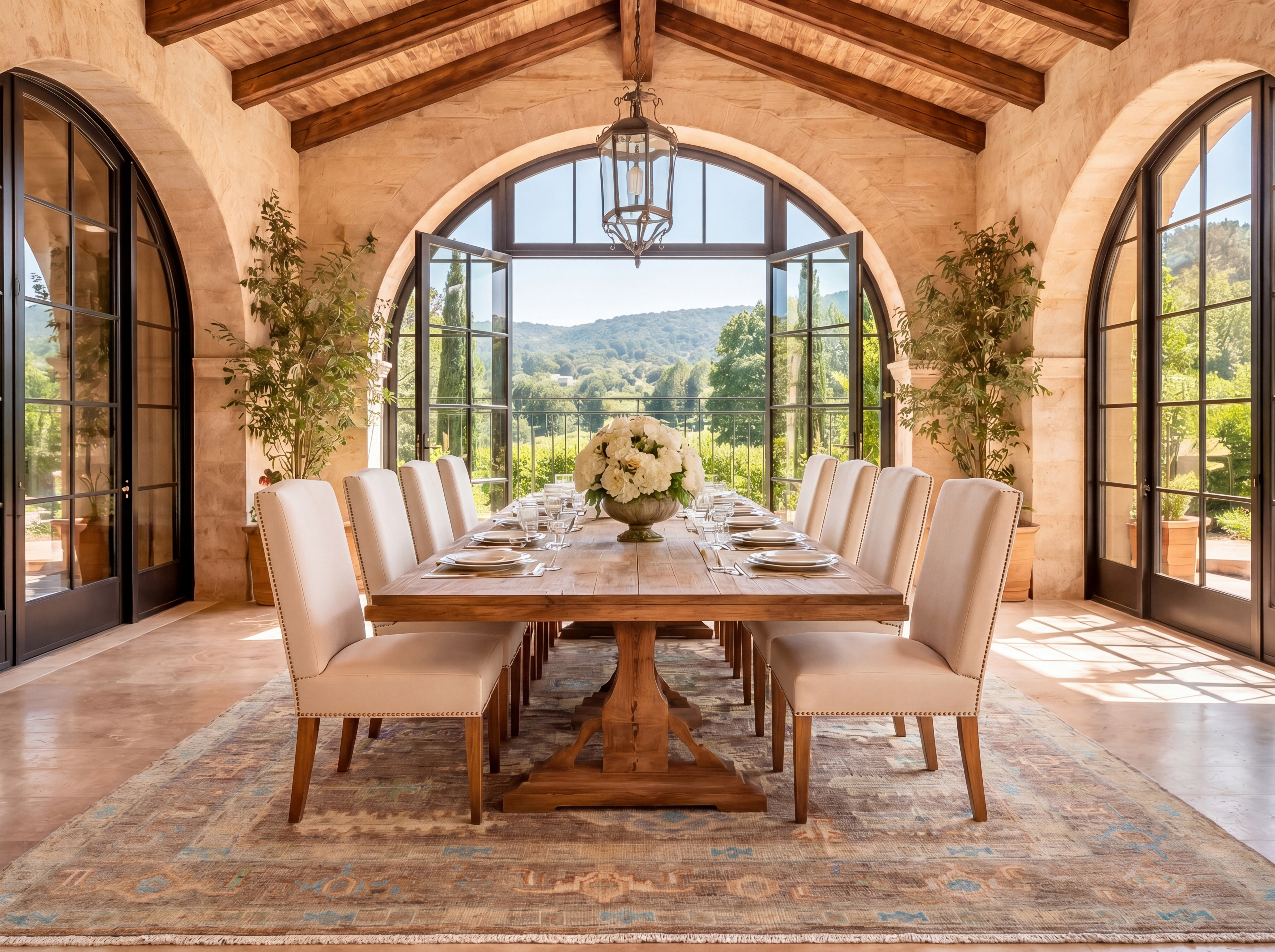
The dining room is where you can afford to go slightly more considered with the rug choice. A hand-knotted piece with a quiet abstract motif or a carved tonal pattern works well here because the furniture gives it some breathing room.
Size matters more in the dining room than almost anywhere else. The rug should be large enough that all four chair legs remain on it when the chairs are pulled out: for a standard six-seat rectangular table, that means a minimum of 8 by 10 feet, and 9 by 12 feet is more comfortable. A wool rug in this context will also benefit from the practical case: wool fibers have a natural resistance to absorbing liquids quickly, giving you time to blot a spill before it sets.
Outdoor and transitional spaces
Modern Tuscan extends naturally to the outdoors. Terraces, covered patios, and sunrooms are central to the Italian farmhouse reference: life is meant to spill outside.
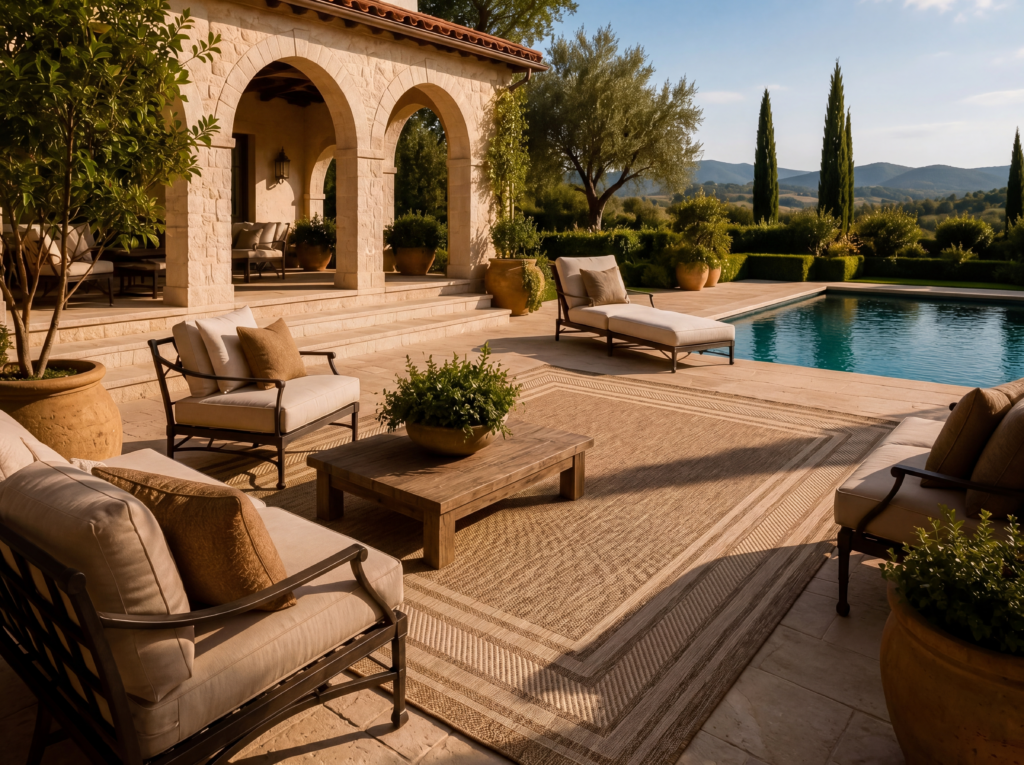
For covered outdoor spaces, the material rules shift. Wool and silk belong indoors. For a patio or terrace that gets weather exposure, look for rugs built specifically for outdoor use, ones that resist UV fading and dry quickly after rain. Stay in the warm, terracotta-adjacent tones and natural-looking textures that read well against stone, tile, or decking.
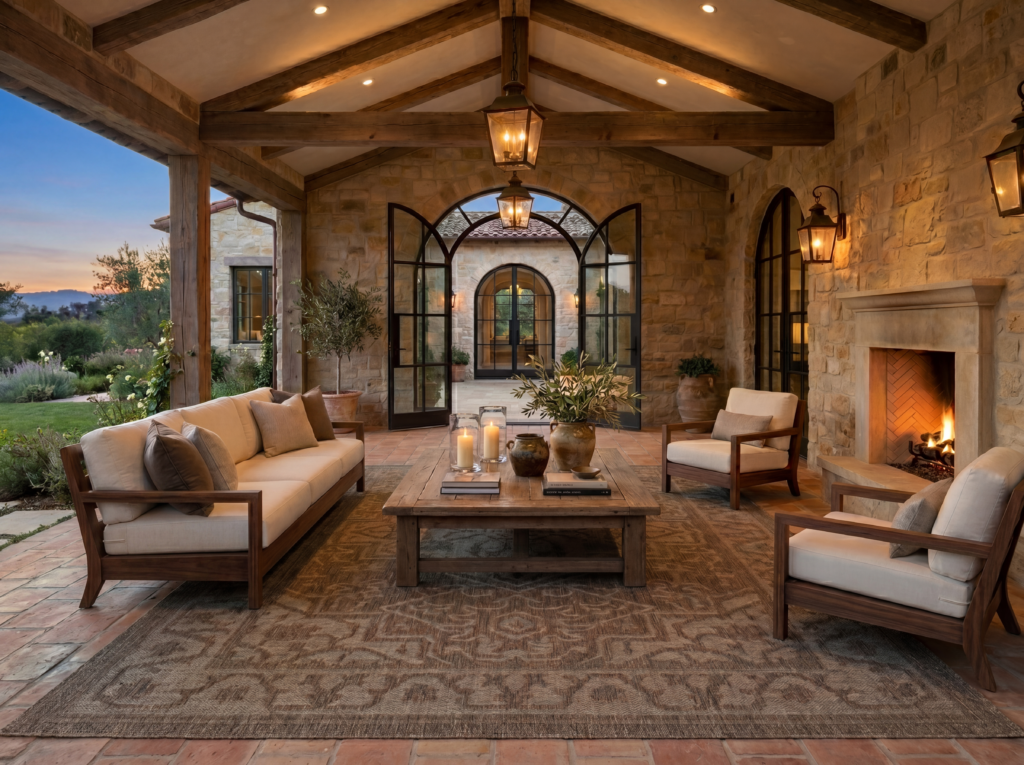
Finish the space with terracotta pots, an olive or lemon tree, unlined linen drapes if there’s shade structure overhead, and low, wide outdoor furniture in natural rattan or teak.
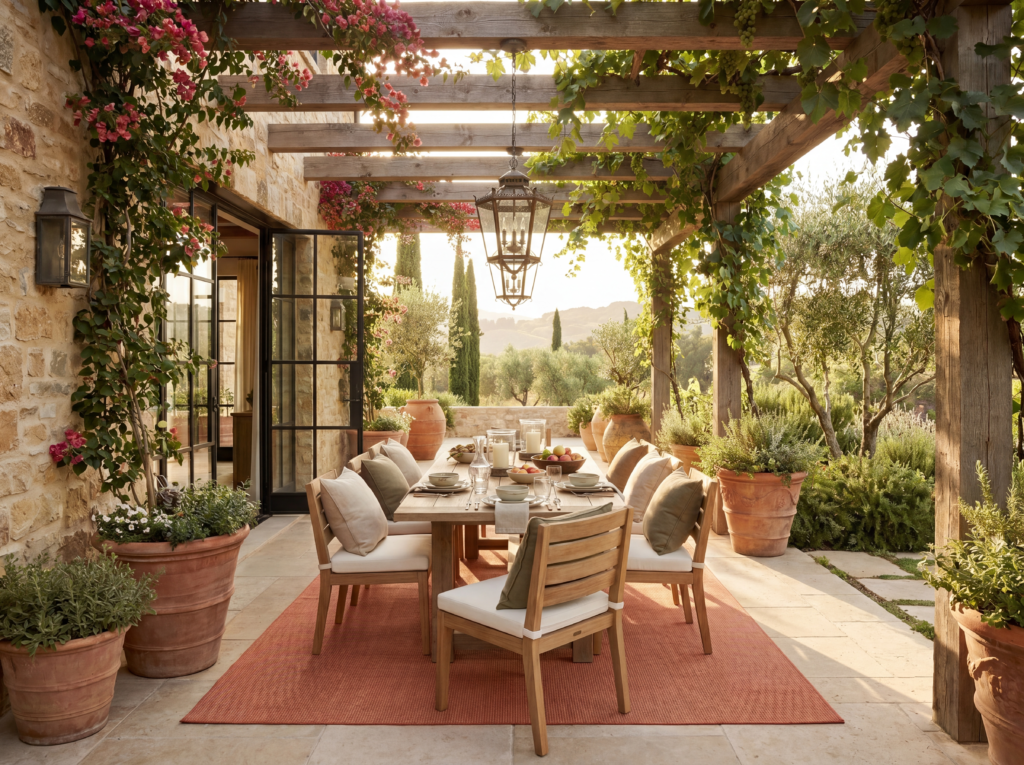
Modern Tuscan home decor: the details that complete the look
Modern Tuscan home decor is less about individual statement pieces and more about what everything feels like together. A few specific additions that work across every room in this aesthetic:
- Lighting: forged iron pendants, aged brass wall sconces, or simple terracotta ceramic table lamps. Nothing polished or chrome.
- Ceramics: handmade or hand-painted pottery in warm neutral glazes. A grouping of three vessels in different heights on a console reads very well.
- Greenery: lavender, rosemary, Italian cypress, fiddle-leaf fig, olive trees. Pots in cement, rattan, or unglazed terracotta. Avoid anything too tropical or too formal.
- Textiles beyond the rug: linen drapes (unlined, floor-length), woven baskets, chunky-knit throws in natural undyed wool or warm sage.
- Art: monochromatic abstracts, antique botanical prints, or simple landscape photography. Avoid busy or highly saturated work. The art should feel like it was collected, not curated.
The 70/30 principle applies here: 70% of the room stays in the warm neutral base (walls, large furniture, the rug), and 30% carries the contrast and character: the terracotta pot, the aged mirror, the handmade ceramic bowl. Too much contrast and the room loses its calm. Too little and it disappears.
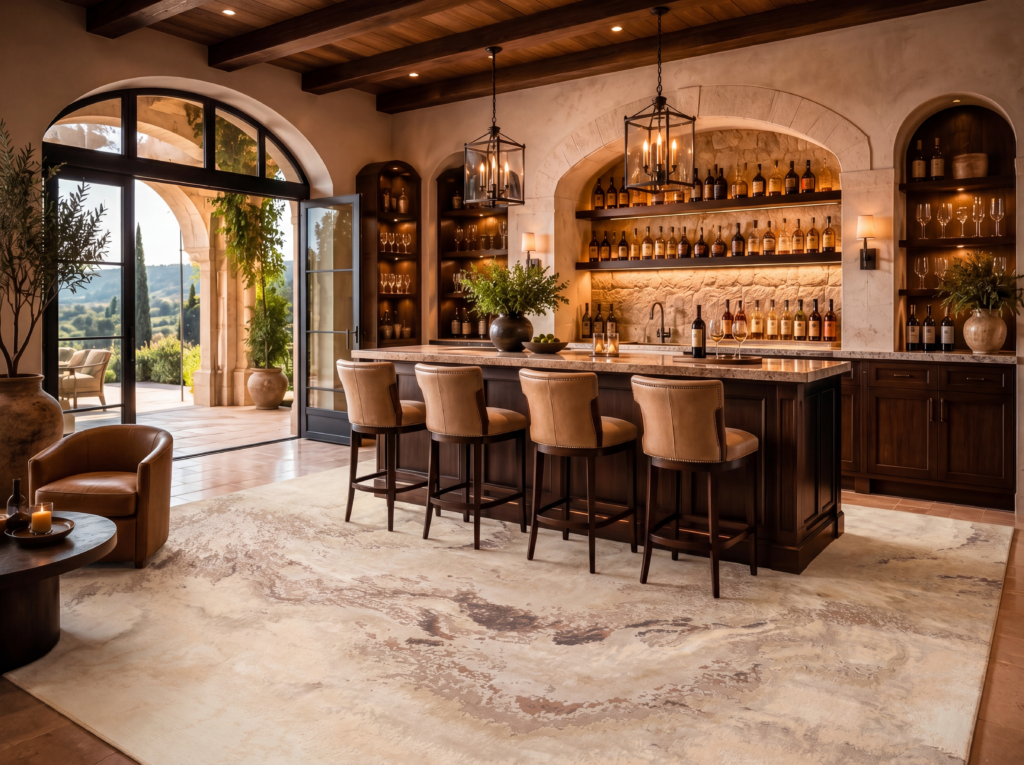
Is modern Tuscan the same as Mediterranean style?
No — and the distinction is worth making because it affects every design decision.
Mediterranean is the broader category. It covers southern European design across multiple traditions: the cobalt blues and whitewashed walls of Greek island architecture, the geometric tilework of Moroccan interiors, the terracotta-roofed farmhouses of coastal Spain. Warm, sun-influenced, yes, but it casts a very wide net and can run vivid and pattern-heavy.
Modern Tuscan is more specific and more restrained. It draws from the particular character of central Italy: muted, ochre-washed hillside towns, interior courtyards with stone floors and terracotta pots, a palette that feels like it’s been softened by five hundred years of the same light. Where Mediterranean can go bold, modern Tuscan stays tonal and quiet.
For practical purposes: if you’re seeing cobalt, heavy tile patterns, or vivid terracotta as a dominant wall color, that’s Mediterranean. If the palette is sand, ivory, sage, and warm grey, with texture doing the work that color would do in another style, that’s modern Tuscan.
What is “New Tuscany” and how does it relate to modern Tuscan?
You’ll see both terms in 2026 design coverage. They refer to the same shift, with slightly different framing.
“New Tuscany” tends to appear in kitchen and architecture contexts. It’s the shorthand for the lighter, cleaner evolution showing up in cabinetry, tile, and stone choices: warm whites and taupes replacing grey, natural stone over engineered quartz, streamlined shapes over ornate ones. The modern Tuscan kitchen is defined by creamy whites, warm wood, simple ceramic tile, and a rug underfoot that completes the grounded, honest-materials feeling, an emphasis on how the room feels to cook and gather in rather than how it photographs.
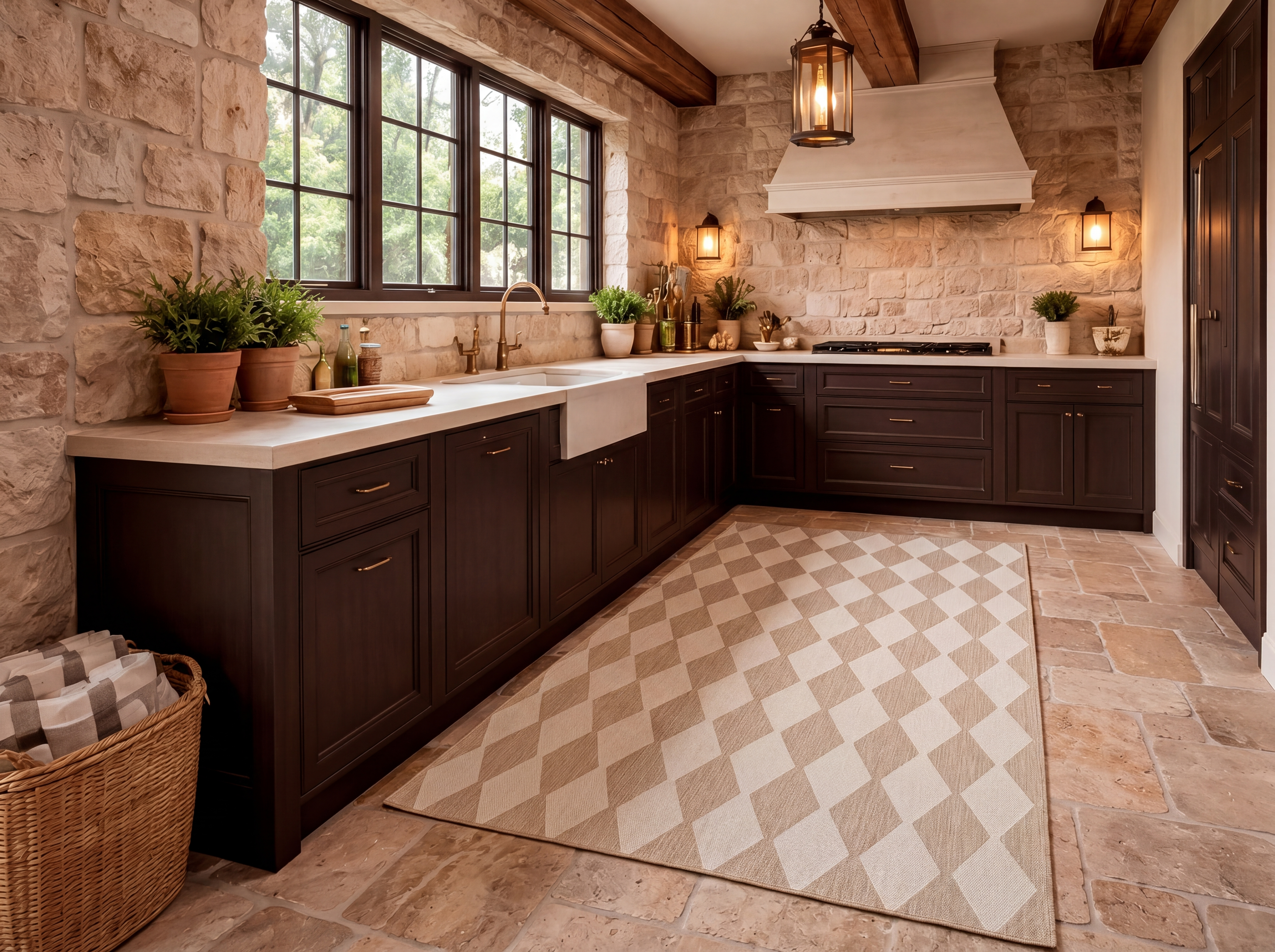
“Modern Tuscan” is the broader interior framing, covering the full room: furniture, textiles, lighting, and the rug that anchors all of it.
What both labels share is the same core principle. Take the warmth and materiality of the original Tuscan aesthetic, strip the heavy ornamentation, and update it for rooms that need to feel genuinely livable rather than theatrically designed. The result is spaces that look like they’ve accumulated character over time, not been assembled in a weekend.
For rugs, both directions point the same way: natural fibers, handmade construction, tonal palettes in warm neutrals. A well-chosen wool or wool/silk rug doesn’t just fit this aesthetic. It’s one of the clearest expressions of it.
Frequently asked questions about modern Tuscan home design
Q: What colors define modern Tuscan interiors?
A: The palette centers on warm neutrals: sand, aged ivory, soft greige, muted sage, and warm grey. Terracotta appears as an accent rather than a dominant tone. The overall effect is lighter and more restrained than the original Tuscan style, which leaned toward deep reds, dark browns, and heavy contrast. In 2026, designers are moving away from cool grey specifically in favor of these warmer, more grounded tones.
Q: What type of rug works best in a modern Tuscan home?
A: Hand-knotted or hand-tufted wool rugs in tonal colorways, specifically ivory, sand, and warm grey, are the strongest choice. Wool/silk blends add a subtle sheen that suits the “grounded luxury” quality of the aesthetic. Natural jute works well in secondary or outdoor-adjacent spaces. Prioritize texture over pattern: carved pile, dimensional weave, and quiet abstract motifs read better in this aesthetic than graphic or ornate designs.
Q: How do you modernize a Tuscan-style home without it looking dated?
A: Edit aggressively. Remove anything ornamental that isn’t also functional. Replace dark, heavy furniture with lower, wider pieces in natural materials. Swap faux finishes for limewash or plaster. Update the color palette from deep reds and espresso browns to warm whites, sand, and sage. In the rug, move away from medallion patterns toward tonal, textured pieces. The goal is a room that feels like it’s been lived in well, not decorated for effect.
Q: Can you mix modern Tuscan with contemporary design?
A: Yes, and that tension is actually part of what makes the aesthetic work in 2026. A contemporary low-profile sofa in bouclé pairs well with a hand-knotted wool rug and aged ceramic accessories. The principle is contrast: one modern piece, one piece with age or patina, natural materials throughout. What doesn’t work is mixing modern Tuscan with cold, high-gloss, or industrial elements. The aesthetic needs warmth to function.
Q: What size rug do I need for a modern Tuscan living room?
A: In most living rooms, an 8 by 10 is the minimum and a 9 by 12 is more comfortable. For modern Tuscan furniture scale, that sizing holds: lower, wider sofas and chairs need a rug large enough to feel proportional. All front legs of the seating should sit on the rug; ideally all four legs of every major piece. In a modern Tuscan room especially, a rug that reads as too small undermines the whole effect. This aesthetic is about generosity and groundedness, and the rug needs to anchor the space with the same confidence.
Modern Tuscan isn’t a decorating project with a finish line. It’s a way of making decisions: prioritize natural materials, allow for imperfection, let things earn their place in the room. The rug is often the first decision and the most lasting one. Get that right and the rest of the room tends to follow.
Browse our Wool Rugs and Outdoor Rugs to find the right foundation for your space. If you’re working on a client project or need custom sizing, our Reserve Custom Studio is built for exactly that.