How to Choose a Rug for Any Workspace: Offices, Studios, and Commercial Spaces
The right rug for a workspace comes down to three things: how the zone is used, how much traffic it takes, and what the floor needs to do beyond look good. A boardroom needs sound dampening and gravitas. A reception needs a first impression. A drafting studio needs a floor that can take a rolling stool for ten years. There is no single “commercial rug,” only the right rug for the room in front of you.
That’s the brief we hear most often from designers working across offices, studios, and mixed-use commercial spaces: not “what’s trending” but “what actually holds up here, and what does it say about the client.” Below is how we’d think through it, zone by zone.
Why Rug Choice Matters More Than It Looks Like It Should
A rug in a commercial space is doing more work than a rug in a living room. It’s managing acoustics in an open floor plan, guiding people from reception to conference rooms without a single sign, and telegraphing brand identity before anyone says a word. In a wellness-minded office, it’s also part of the biophilic case, natural fiber, warm color, softness underfoot in a room otherwise built from concrete and glass.
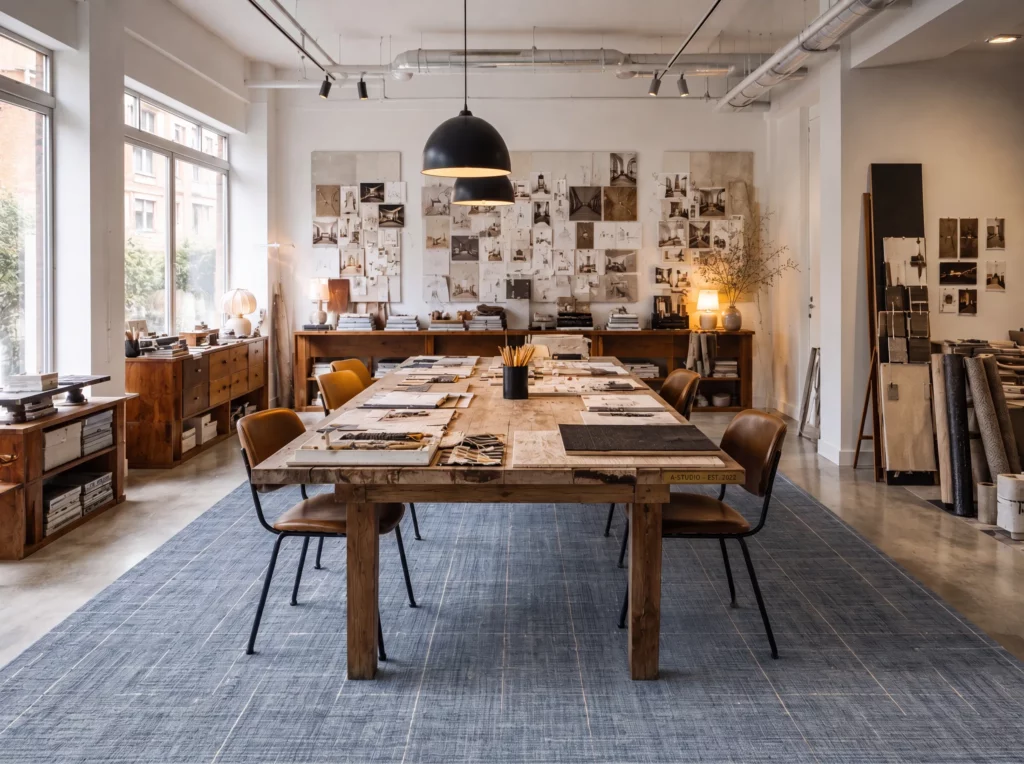
Skip the rug decision, or treat it as an afterthought once the furniture is in, and you lose all three functions at once. A hard-surface conference room with no floor covering echoes. A lobby with a stock doormat instead of a considered rug reads as unfinished. None of this requires a huge budget shift. It requires sequencing the decision earlier.
Read the Space Before You Open the Sample Book
Before any pattern or fiber conversation, walk the space with four questions:
What’s the traffic pattern? A rug directly in a walking path wears differently than one anchoring a seating group. Rolling office chairs are harder on pile than foot traffic alone, so note every desk, workstation, and conference chair that will sit on or near the rug.
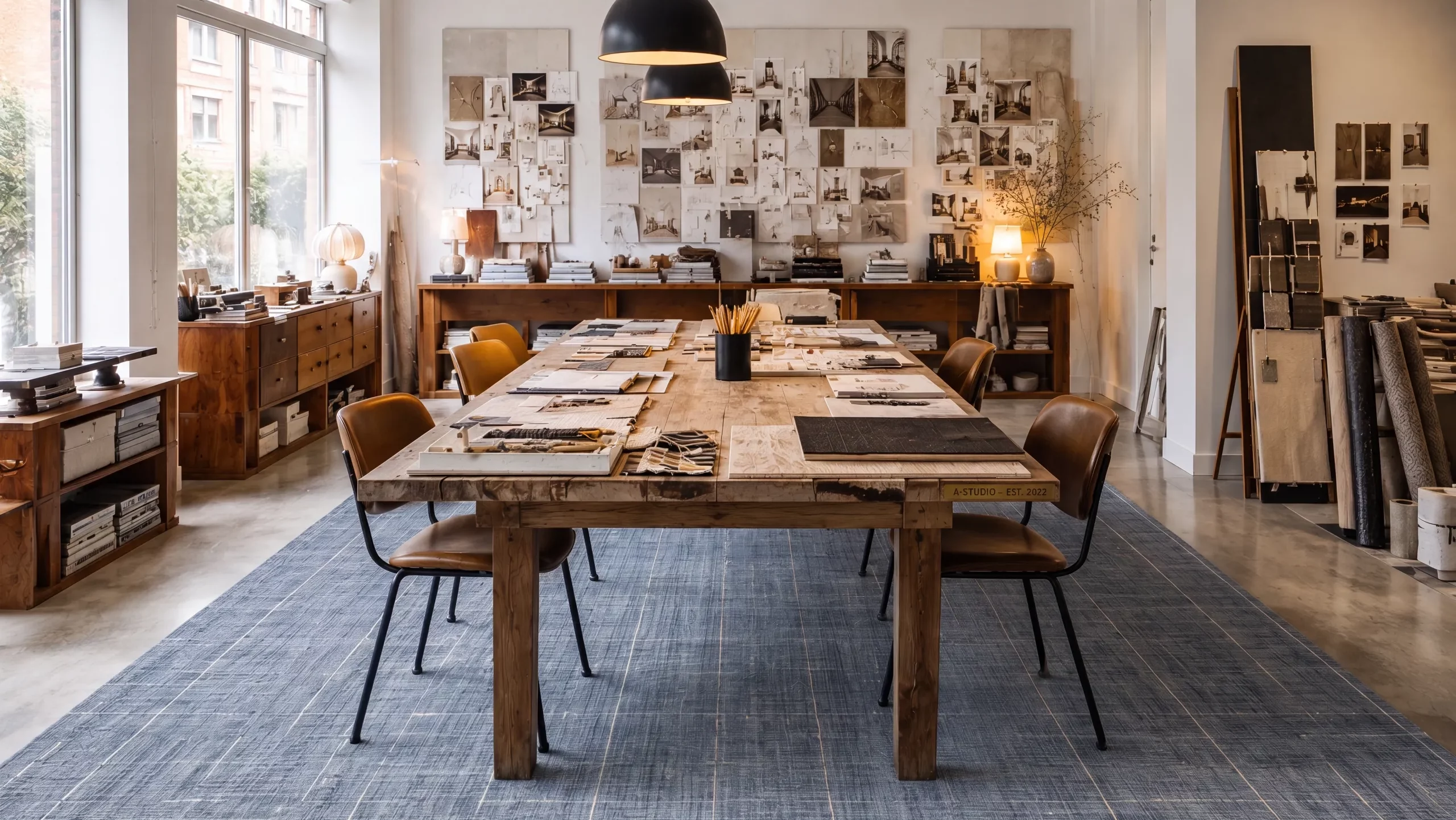
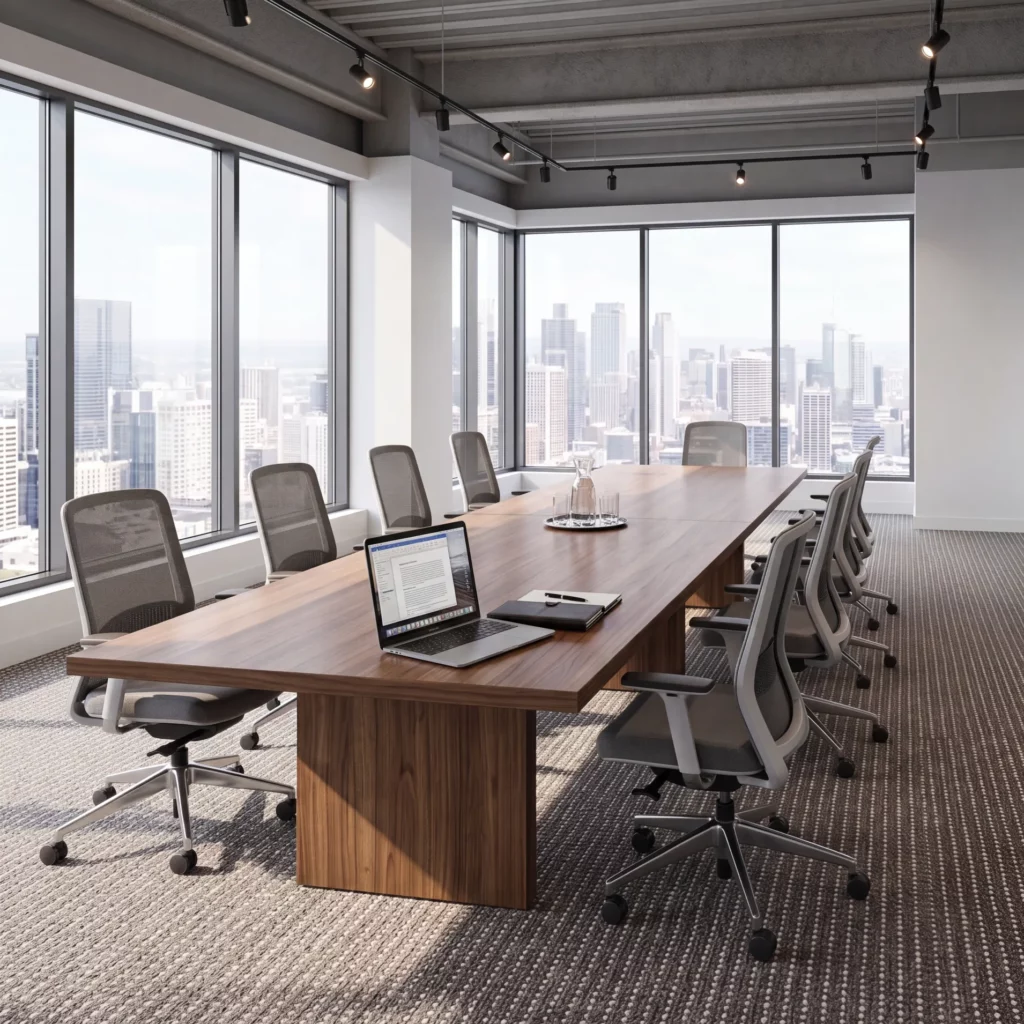
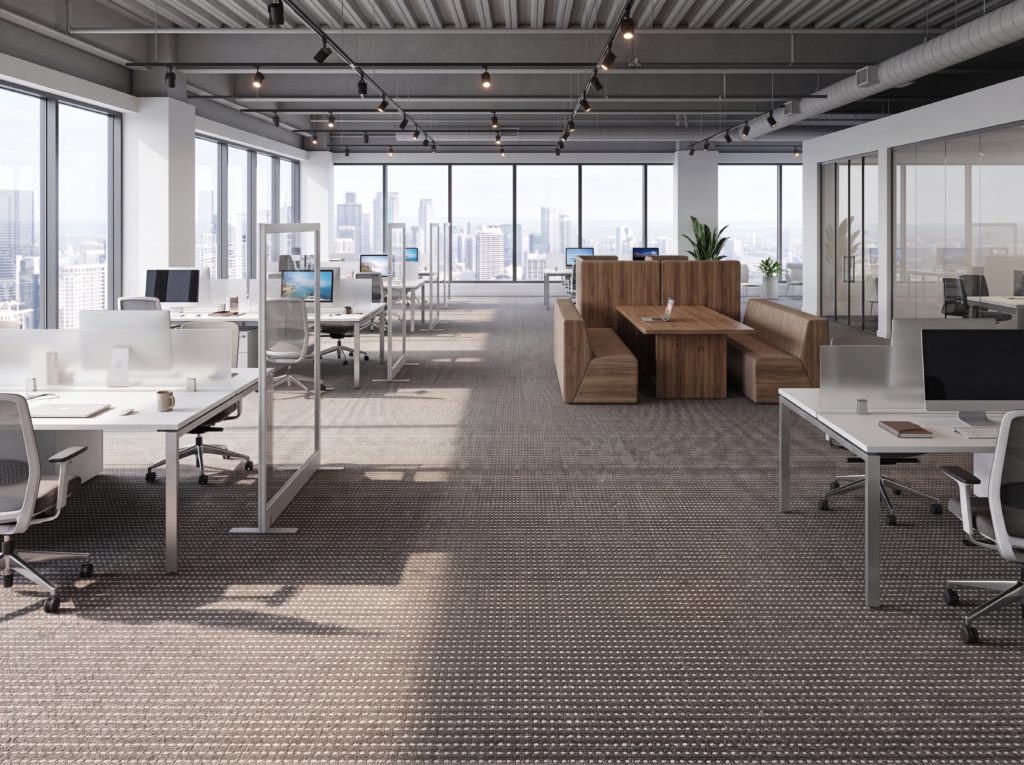
What’s the ceiling height and light? Tall ceilings and floor-to-ceiling glass, the kind you see in a high-rise boardroom, make small, tonal patterns read as texture rather than clutter. Low, intimate rooms can carry more pattern without feeling busy.
What’s the existing material palette? Walnut millwork, poured concrete, brushed steel, painted drywall, each of these needs a different colorway to feel resolved rather than competing. A rug is one of the largest single material choices in a room; it should be selected after the hard finishes are locked, not before.
What’s the room actually for? A collaborative floor with hot desks needs something entirely different from a private office meant for focused, one-on-one work. Match the rug’s job to the room’s job before you match it to the mood board.
Broadloom vs. Area Rugs vs. Modular Carpet Tile
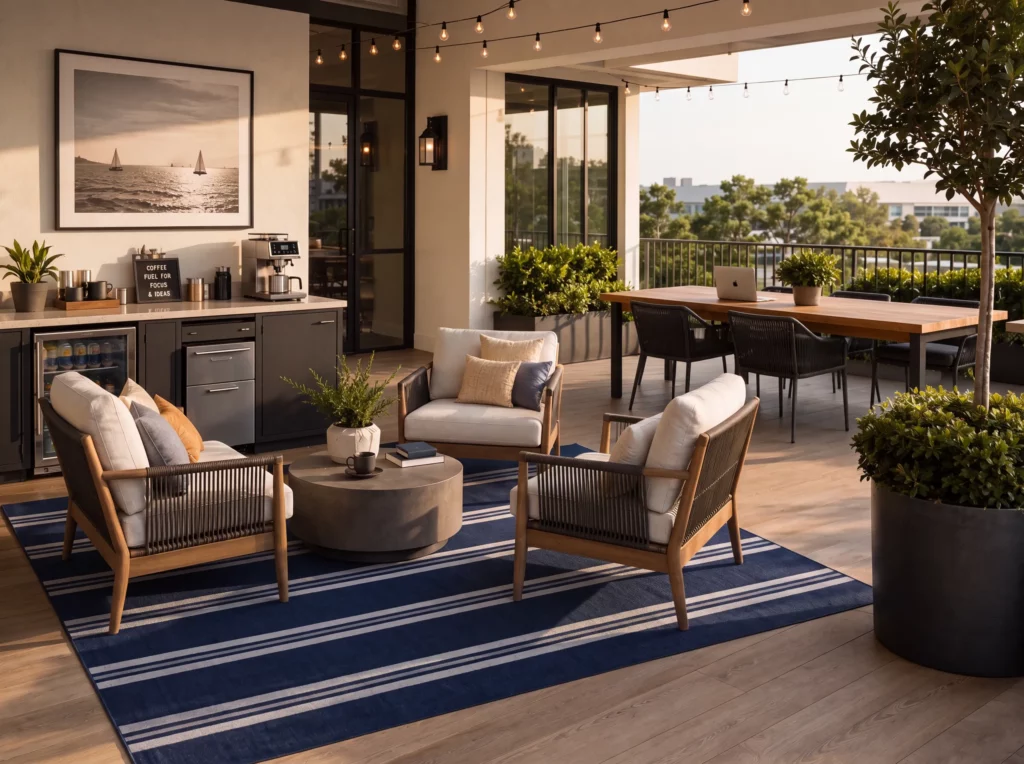
Three formats, three very different use cases.
Broadloom is wall-to-wall carpet, installed from a continuous roll. It’s the right call for open-plan floors, private offices, and any room where you want full acoustic coverage and a seamless look. It’s typically the most cost-effective option per square foot for large footprints, and it eliminates transition strips between rug and hard flooring.
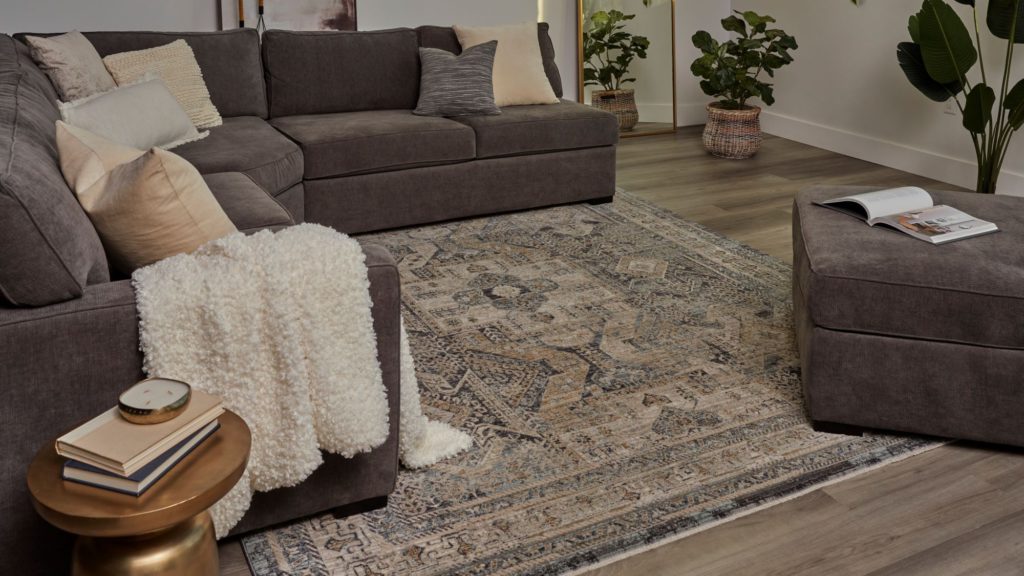
Area rugs define a zone within a larger hard-surface floor: a seating group in a lobby, a table in a coffee nook, a conversation area off a hallway. They’re easier to swap out, easier to size precisely to furniture groupings, and they let you layer pattern and texture against concrete, tile, or wood without covering the whole floor.
Modular carpet tile is built for flexibility and repair. If a section wears out, stains, or needs to be pulled for cabling access, you replace the tile, not the room. This makes it a strong choice for tech offices, co-working floors, and any space where the floor plan might change in eighteen months rather than eight years.
Quick framework: full-floor acoustic coverage in a fixed layout, go broadloom. Defining zones within an open or hard-surface floor, go area rug. High-change environments where flexibility and easy repair matter more than a seamless look, go modular tile.
Pattern and Scale in Large-Format Spaces
The instinct in a big room is to go big with pattern to match. Often the opposite works better. A small, evenly distributed repeat, dot, herringbone, subtle geometric, reads as texture from a distance and detail up close, which means it holds up whether someone’s viewing it from a doorway or standing on it. Bold, large-scale motifs can dominate a room the size of a boardroom or open floor, competing with furniture, art, and the view instead of supporting it.
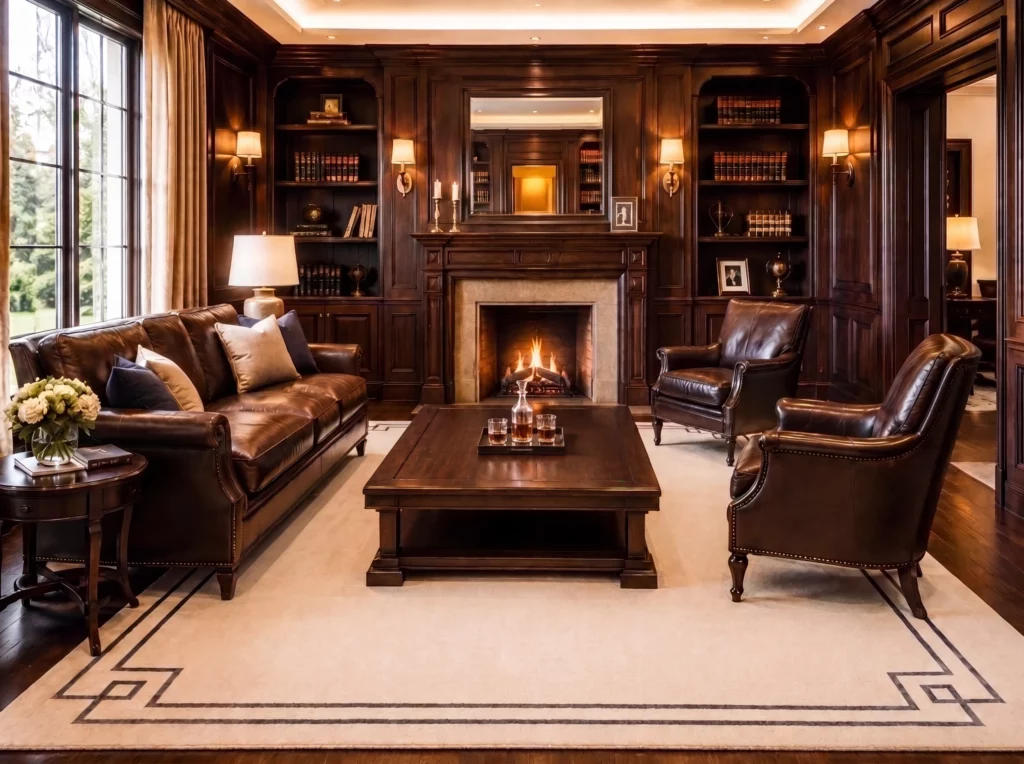
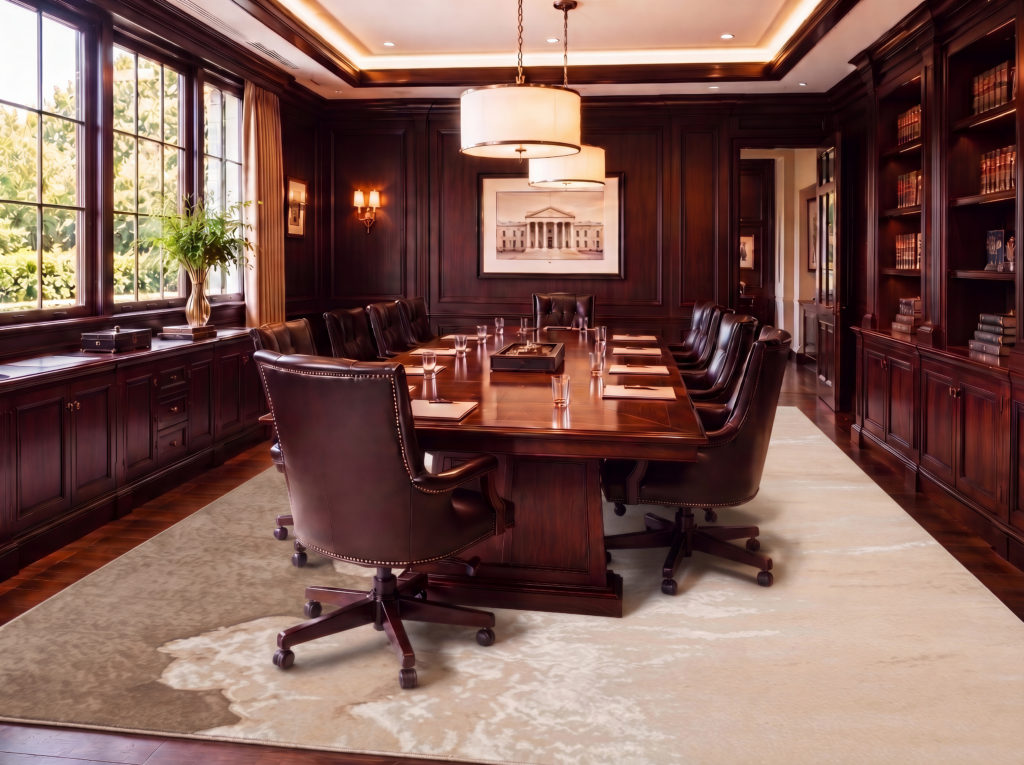
This is also where a hand-knotted pattern like Christopher Guy Wool and Silk CGS10 Mediterranean Sand earns its place. In a wood-paneled boardroom or private office, a soft geometric border in tonal sand and cream reads as quiet formality rather than pattern for pattern’s sake, which is exactly what a room built to convey authority needs.
Zone-by-Zone Guidance
Boardrooms and Conference Rooms
Durability and sound dampening come first here, but so does the room’s overall register. Rolling executive chairs, a table that rarely moves, and a room meant to project confidence all point toward a dense, low-to-medium pile with a refined, tonal pattern rather than a bold statement piece. In a traditional dark-wood boardroom, a hand-knotted rug in warm sand and cream, like the ones in our Christopher Guy Wool & Silk collection, grounds the space without competing with the paneling, brass fixtures, or the art on the wall.
Open Workstations and Collaborative Floors
Heavy traffic, rolling chairs, and daily wear mean fiber choice matters as much as pattern here. Solution-dyed nylon or polypropylene resists staining and holds color under constant foot and chair-caster traffic. Seaming matters too: broadloom installed with minimal seams in high-traffic zones reduces the wear points where fibers fray first. A denser, tighter loop or cut-loop construction, rather than a plush shag, will outlast a softer pile under rolling office chairs by a wide margin.
Reception and Lobby
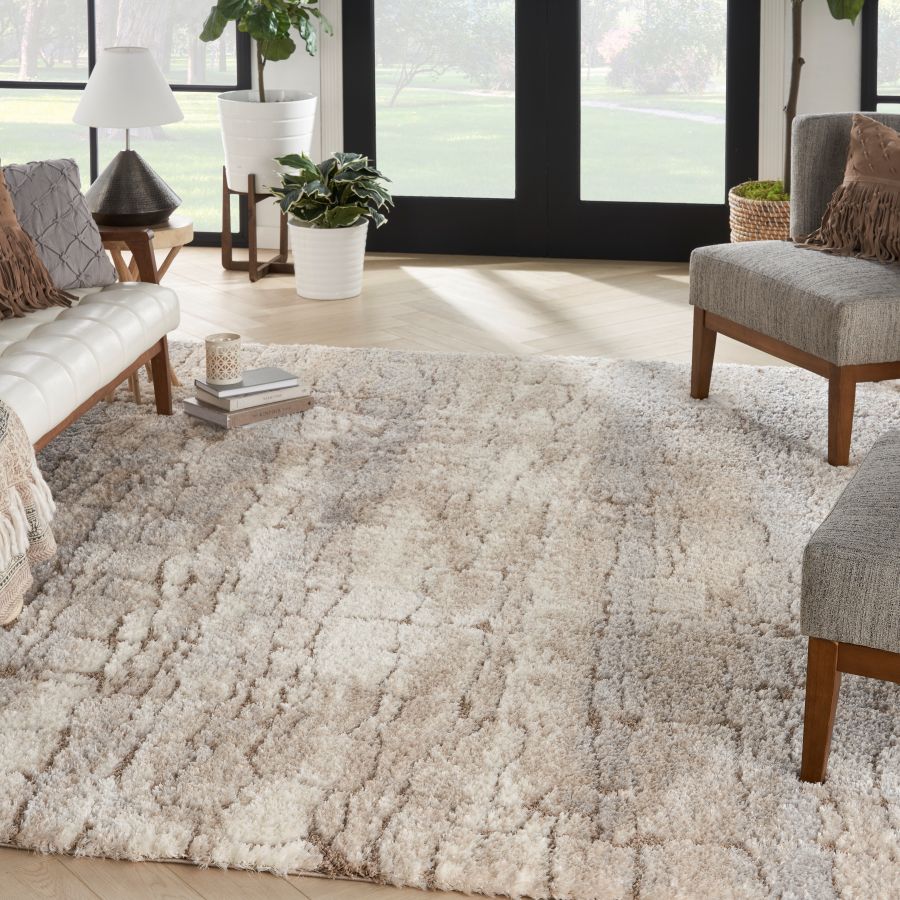
First impressions happen here, and so does the brand-identity conversation. A rug in reception can be a deliberate landing zone against a hard-surface entry floor, exactly the effect in our Plush Cloud rug in Taupe, sized generously beneath a seating group so it reads as intentional rather than incidental. Solid, tonal colorways work well in reception because they photograph cleanly and don’t compete with signage, art, or logo placement, while still softening the acoustics of a typically hard-surfaced entry.

Private Offices and Focus Rooms
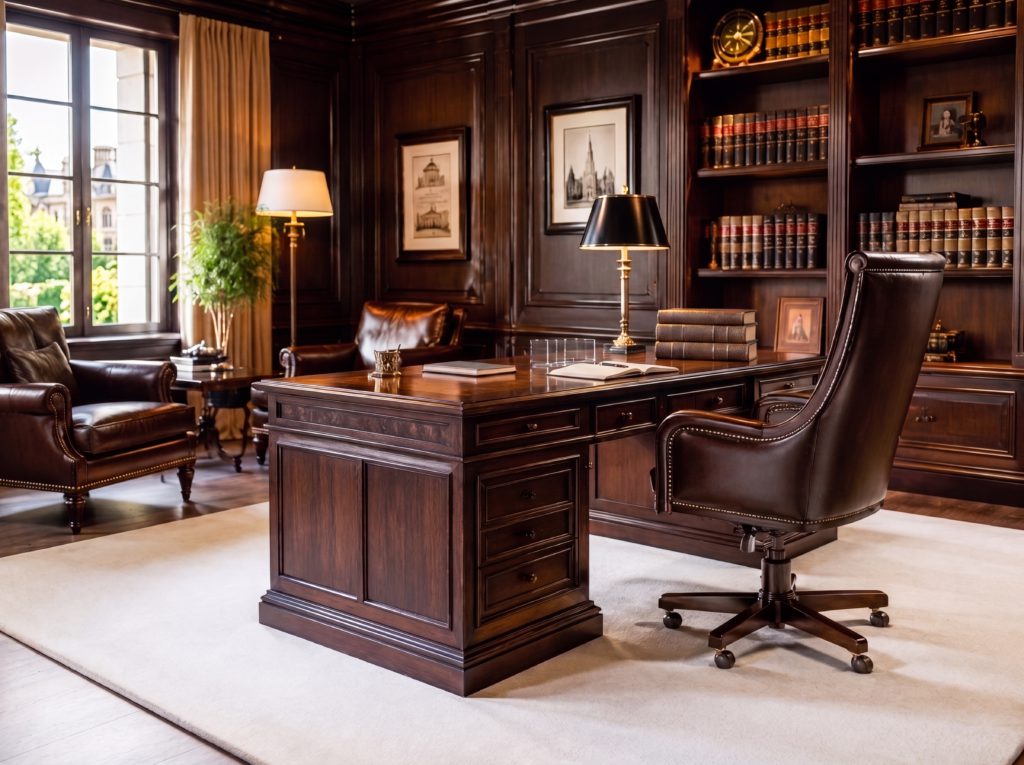
Acoustic softness and personalization matter most in single-occupant spaces. A plush pile, like Plush Cloud in Ivory, underfoot in a private office adds a layer of quiet that a hard floor alone can’t, and because the room is smaller, it’s a place to size a rug precisely to the desk and seating area rather than wall to wall. This is also where a client’s personal taste can show up more than it would in a shared conference room, a warmer palette, a more traditional pattern, or a bolder color than the rest of the floor would carry.
Color and Material Specification for Commercial Durability
The rug that photographs beautifully on day one needs to still look right at year three. That comes down to fiber and construction, not just color.
Solution-dyed fiber carries color all the way through the strand rather than as a surface coating, so it resists fading from UV exposure and doesn’t reveal wear as a lighter patch where traffic is heaviest. This matters enormously in glass-walled offices and daylight-heavy commercial floors, where a surface-dyed fiber can visibly fade within a year or two of direct sun exposure.
Commercial-grade backing affects how a rug performs under rolling chairs and heavy furniture. A dense, low-profile backing resists crushing and keeps the rug from shifting underfoot, which matters in high-traffic zones where a rug that creeps or bunches becomes both a wear issue and a safety issue.
Stain resistance is a construction property, not just a marketing claim: tightly twisted, heat-set yarns resist soil penetration better than looser, untreated fibers, which is why commercial specifications lean toward polypropylene, nylon, or treated wool blends over untreated natural fibers in high-spill zones like coffee nooks and breakrooms.
Fade resistance under glass deserves its own line item, since floor-to-ceiling windows, a defining feature of most modern commercial builds, intensify UV exposure well beyond what a residential window delivers. Specify solution-dyed synthetic fiber or a UV-stabilized natural fiber blend for any rug placed within direct line of large glazing.
When Off-the-Shelf Isn’t Enough: Going Custom
Some spaces simply don’t match a stock size, shape, or color story, an irregular floor plan, a brand palette that needs to be matched exactly, or a signature space like an executive boardroom or lobby where a one-of-a-kind piece is the whole point. That’s the gap our Reserve Custom Studio program is built to close.
The process starts with choosing a design from hundreds of patterns in the library, selecting yarn colors, and specifying the rug’s size and shape. You’ll receive a computer rendering within two weeks to review before production begins, and an 18-inch by 18-inch strike-off sample is available for seventy-five dollars if you want to see and feel the actual yarn colors before committing. Rugs are hand-knotted, with a fifty percent deposit required to start production and a shipping window of roughly four to five months for pieces up to ten feet by fourteen feet, longer for larger sizes.
Reserve Custom Studio Kit with 500 Color Poms and 15+ Construction Samples
Designed to specification, not limitation.
- 500+ Color Poms: A full yarn library in real wool and silk, organized for fast, accurate palette selection.
- 15+ Construction Samples: Hand-tufted and hand-knotted qualities to compare texture, pile height, and finish side by side.
- True-to-Life Color: See and feel actual yarn color, not a screen approximation, before a single knot is tied.
- Studio-Ready Case: A compact, portable set built to travel between studio, client meeting, and job site.
- The First Step in DesignNow: The physical foundation for the online design and specification process, from palette to finished rug.

A Quick Specifier’s Checklist
- Pile height: low to medium pile for high-traffic and rolling-chair zones; plush or high pile reserved for lounges, private offices, and low-traffic areas
- Fiber type: solution-dyed nylon or polypropylene for durability and color retention; wool or wool blends for boardrooms, private offices, and lower-traffic luxury applications
- Backing: commercial-grade, low-profile backing for stability under furniture and rolling chairs
- Size constraints: measure furniture groupings first, then size the rug to extend a few inches beyond the front legs of seating for a resolved look
- Lead time: stock collections typically ship in days; custom programs like Reserve Custom Studio run three to five months depending on size
- Budget tiers: broadloom generally offers the lowest cost per square foot for full coverage; hand-knotted and custom pieces carry a premium tied to material and construction time
Frequently Asked Questions
Q: What type of rug is best for a high-traffic office? A: A low to medium pile in solution-dyed nylon or polypropylene, installed as broadloom or modular carpet tile, holds up best under daily foot and rolling-chair traffic. Solution-dyed fiber resists fading and stains better than surface-dyed alternatives.
Q: Should a conference room have a rug or hard flooring? A: A rug or wall-to-wall broadloom improves acoustics significantly compared to hard flooring, reducing echo during meetings and calls. A dense, low pile in a tonal pattern balances durability with the formality most conference rooms need.
Q: How do I choose a rug size for an office reception area? A: Size the rug so all the front legs of the seating group rest on it, with the rug extending at least six to eight inches beyond the outer edges of the furniture arrangement. This keeps the grouping visually anchored rather than floating on a rug that reads as too small.
Q: What’s the difference between broadloom and modular carpet tile for offices? A: Broadloom is installed from a continuous roll and gives a seamless look, best for stable, fixed layouts. Modular carpet tile is installed in individual squares that can be replaced piece by piece, making it better suited to spaces where flexibility, cabling access, or easy repair matter more than a seamless finish.
Q: How long does a custom rug take to produce? A: Through a custom program like Reserve Custom Studio, expect a computer rendering within two weeks of placing your order, with production and shipping taking roughly four to five months for rugs up to ten feet by fourteen feet. Larger sizes may take longer.
Q: Can commercial rugs resist fading from sunlight? A: Yes, if the fiber is solution-dyed rather than surface-dyed. Solution-dyed fibers carry color through the entire strand, which resists UV fading in glass-walled offices and daylight-heavy commercial spaces far better than surface-treated fibers.